


Motivation
Industry 4.0 was proclaimed as a strategic objective for the future of industrial production technology at the Hannover Messe in 2011. Modern approaches from information and communication technology are to be transferred to operational technology (OT). In practice, this creates the need to operate the heterogeneous landscape of systems for control, monitoring, and optimization in an interoperable manner. However, the implementation of this vision has lagged behind expectations, as its realization amounts to a fundamental paradigm shift. Moreover, there is no single correct way to solve the problem; rather, there are different solution variants, some of which rely on mutually incompatible building blocks. The Stuttgart Machine Factory is a concrete implementation project of the Industry 4.0 vision and demonstrates a software-defined solution approach in an industrial environment.
Realization
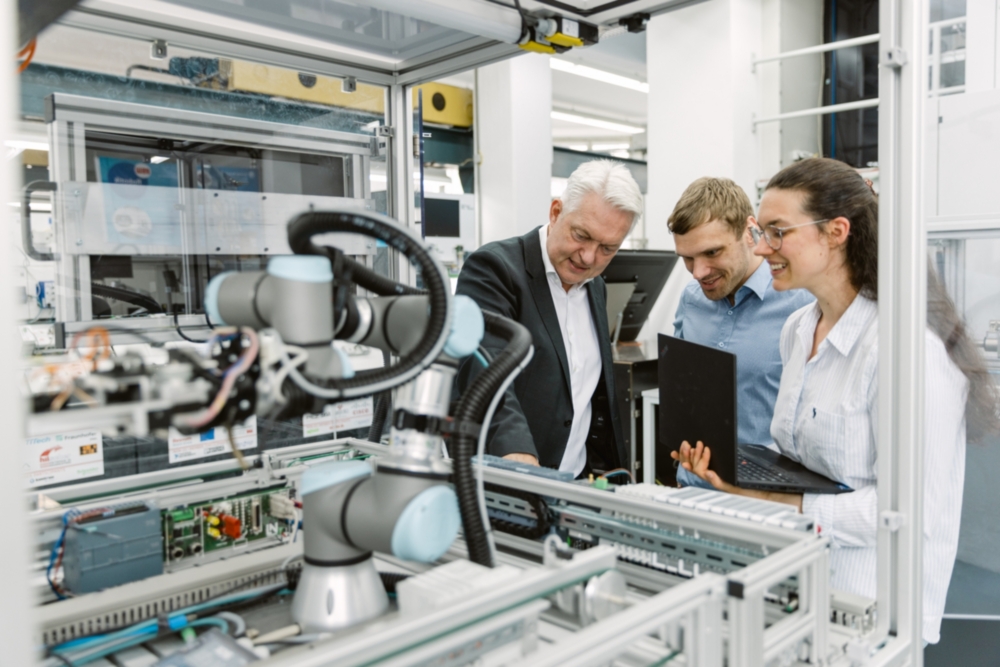
In the Stuttgart Machine Factory, products can be manufactured in batch size 1 on different machines using different production processes. From an architectural perspective, the approach follows the basic idea of splitting production hardware and software into three layers, modeled on the concept of virtualization in computer science. In this structure, the lower layer (technological infrastructure) is consistently separated from the upper layer (applications) by means of an abstraction layer. The task of the technological infrastructure is to provide computing resources (field devices, IPCs, edge nodes, cloud computers) and connectivity. It also includes technologies such as container virtualization, virtual machines, OPC UA, TSN, and others. The abstraction layer above it represents these hardware and software objects, as well as the products to be manufactured, in the form of asset administration shells. It serves as the interface between the infrastructure and application layers and enables the development of applications without requiring knowledge of the underlying infrastructure. The applications use the abstraction layer as a source and sink of information and include services such as CNC control, condition monitoring, optimization of production processes using the digital twin, virtual product manufacturing for quality prediction, and many more.
Get in touch

Johannes Clar
M.Sc.Group Leader "Mechatronic Systems and Processes"

Nicolai Maisch
M.Eng.Group Leader "Software and Engineering Methods"